Of Pride and Place
Mark Mitchell
by Nate Lippens · Photographs by Julius Schlosburg
Originally published in Maggot Brain*, Issue 21, Summer 2025. Reprinted with permission.*
"I'm drawing my coven close," Mark Mitchell says from the Tucson home he lovingly calls his compound.
We've been messaging and texting, and now, at the beginning of February 2025, I'm talking with him on the phone, listening to his familiar voice and cadence as if no time has passed since we both lived in Seattle seventeen years ago. Our conversation has launched over our former city and been sidetracked by some pertinent gossip before plunging into the heart of the matter: Mitchell is preparing work for an ambitious mini-survey of textiles and ceramics at Tucson's Pidgin Palace Arts, which will open on May 3, 2025.
In conversation, Mitchell is chatty yet direct, dark-humored and steeped in camp and the encyclopedic sensibility of underground and arcane cultural streams. He works with textiles, clay, costumes, and objects, a creative swirl that pulls from his vast knowledge of design and art—Maison Clergeat, Musée des Arts Décoratifs, Erté, René Lalique, Billy Baldwin, Judy Blame—and smashes through the lines between fine art, folk art, and decoration. His upcoming show includes selections from two past bodies of work, Burial and White Work, and brand-new ceramics, including a large installation about, he says, "our queer family and revolution."
Since moving from Seattle to Tucson eight years ago, Mitchell has been working with clay. He volunteers two mornings a week at a clay co-op, loading and unloading kilns, firing and glazing pots and sculptural works by others, and he has built a community there. The environment has emboldened him. "I'm in the beginning throes of this new body of ceramics. After three years in clay, I have the skills to make actual art rather than little vases and things. The new work is stretching out."
The process has been arduous, but Mitchell is drawn to intensive labor and sprawling projects; Burial, his exhibition of funeral wear for the dead, exhibited at the Frye Art Museum in 2013, and included nine pieces that took four hundred hours of hand stitching. Kurt Reighley, Mitchell's husband (they have been together for twenty-three years; married for five), knows the process intimately; he describes Mitchell's work as "always metastasizing."
Though Mitchell works with textiles and creates costumes, fashion doesn't hold his interest much. In that respect, he's in league with the British raconteur-author Quentin Crisp who said, "Fashion is what you adopt when you don't know who you are. Style is deciding who you are and being able to perpetuate it. Taste is something I deplore." In a way, Mitchell calls to mind Christian Bérard, also known as Bébé, the French artist, fashion illustrator, and designer who collaborated with Jean Cocteau and Dior, and who could move between mediums and make wild leaps of invention and mastery—but only if Bébé had grown up on glam, punk, camp, David Wojnarowicz, and Klaus Nomi, and only if he had kept fastidious house and kicked the drugs.
Mitchell is the kind of independent artist that hardly exists now. Non-MFA'd, anticareerist (not as a stance, from genuine disinterest), and poor in an age that has again returned to seeing anything less than self-branding hypergreed as a moral failure, or at least an aesthetic one. When Mitchell discusses pride of place, it's not a gallery or museum; it's that photographer Peter Palladino has candlesticks made by Mitchell on the mantel in his house in California, one designed by the early modernist painter/desert transcendentalist Agnes Pelton.
Mitchell says he is making peace—or a variety of truce—with some of his past. "The last three weeks I've had morning candles and incense with my father," Mitchell says. "I don't usually call on my blood ancestors. I don't trust them." Like many of us, he comes from a legacy of cruelty, mental illness, and secrets. Growing up in a hyperconservative small town in central Illinois, a queer kid in the 1960s and 1970s (which culturally was still the 1950s), Mitchell was strange. Creative and curious, he taught himself to sew, knit, and crochet, and by his teens, he was making clothes.
Mitchell's older brother, "an illustrator, beautiful drawings," suffered from schizophrenia compounded by "mega amounts of LSD." Witnessing his brother's passion and skill convinced Mitchell that art was a transcendent calling, and seeing his brother's gift blighted and truncated by illness left a mark and a motivation. "It's hard to say what he would have created," Mitchell says, "but my practice is affected by the work he didn't get to make."
One of five children, Mitchell had a relationship with his mother and his siblings that fluctuated over the years but never stayed good for long. His eldest brother and younger sister are now both dead, as are his parents. He doesn't speak to either of his living brothers, and he skipped his mother's funeral.
Mitchell was out of the house at seventeen, "young, with a round ass, totally unprepared." There were older men—one took him to the Gold Coast in Chicago, the original leather bar—a general lack of direction, a stint in a mental hospital, and a period of being medicated on Thorazine. "Chemical handcuffs," Mitchell recalls. "My mother would wake me up, 'Time to get up, Mark,' and I'd shuffle off to the TV and sit, watching all day, and she'd come get me when it was time for bed."
Eventually he found himself at Arizona University, where he studied costume design for a few semesters, followed by a summer job with Phoenix Little Theatre. The summer gig turned into a full-time job. Mitchell left Arizona for Los Angeles in 1984, and moved to Seattle with friends shortly afterward. The city had a thriving theater scene and a plethora of costume design jobs.
AIDS was a constant specter, "a horror movie." Friends died; lovers died. The isolation and terror of the disease was compounded by the virulent and violent homophobia megaphoned from pulpits (there's no hate like Christian love), as well as the media (conservative ghoul William F. Buckley Jr. published an op-ed in the New York Times, suggesting HIV-positive people should be tattooed on their buttocks and wrists to warn the public), and politicians such as Senator Jesse "Compromise, hell!" Helms. The message from society was simple: drop dead. As Mitchell and I discuss that time, using a private shorthand language for queer men of our generation, we underplay it, because if you know, you know. It goes unsaid that the embers of rage and bone-deep distrust are still alive in us.
In 1992, Mitchell's lover Tom was dying in the hospital, and Pat Robertson was speaking at the Republican convention. "I buried myself in crystal meth," Mitchell says, "and went to a bathhouse where I contracted HIV." He was thirty, overwhelmed by grief and mortality and anger. He left the theater world and became a tattoo artist: "I drank and did a lot of drugs. I shoved my gifts aside because I was furious and thought, fuck it, the world doesn't deserve them. I lived like I was going to die, because everyone around me was." Self-destruction in a world telling you to die feels redundant, maybe even a way to beat society to the punch.
A decade later, in 2002, Mitchell met Reighley, a writer and DJ with a quick wit and sharp intellect. Too, Reighley possessed a sly buoyancy and deep-rooted kindness that countered the darkness Mitchell had been in. The relationship pulled him back from the brink, and he realized he wanted to make clothes again, but differently. First, he designed costumes for the burlesque star Marc Kenison (aka Waxie Moon), including a red tulle gown for a striptease performance at On the Boards, and worked with the designer Anna Telcs for Implied Violence, an exhibition at the Frye. The projects were more collaborative, the wearers less clients than friends and muses.
In 2013, Greg Lundgren, a curator and the owner of Lundgren Monuments, a headstone business, approached Mitchell about contributing to The Softer Side of Death, a group exhibition of urns made from fabric. Mitchell's piece was constructed of 275 pieces of hand-dyed ombre silk and a drawstring, designed to be released in the sea, where the fabric would disintegrate and disperse the ashes.
With shrouds on his mind, Mitchell began work on Burial in the tight confines of his studio, a loft in his Capitol Hill home. With four assistants, using hand-sewing techniques dating back to the 1930s and '40s, Mitchell produced nine ensembles, including gowns, jackets, trousers, chiffon gloves, stockings, undergarments, handmade wooden buttons, moccasins, and silk slippers. The gowns and jackets included hidden details such as embroidered doves and personal messages for the wearer, stitched in ivory thread.
The models, whom Mitchell referred to as "muses," included artists and friends. In Marcy Stone-Francois's 2013 documentary Mark Mitchell: Burial, Mitchell, seated on his sofa in his living room, says, "Why not dress you for death—that way I get you for all eternity," and chuckles.
Burial opened on September 20th, 2013, to a full house: one thousand people attended, and the overflow had to be turned away. Mitchell's muses, wearing their death finery, were laid out on coffin-like mirrors on the floor, beneath the museum's salon-style installation of nineteenth century German and Austrian paintings. The muses lay with their eyes closed, except for the occasional involuntary twitch, while Lori Goldston played a cello solo improvised for the occasion. It was a living wake, and some visitors were overcome with emotion.
After the opening night's living dead installation, the ensembles were moved to mannequins, which gave viewers a 360-degree view of the garments. The regal, transcendent, and subversive nature of the work could be seen in all of the artist's glorious attention to detail—embroidered soles on slippers that would never be walked in, overlong gloves for stiff fingers. It was stunning.
Following the phenomenal success of Burial, there were false starts and setbacks, including the collapse of a residency program, and the feeling of being creatively cock-blocked by locally powerful people. Mitchell had gained attention and acclaim, but he still remained outside the perversely convoluted way the visual art scene worked.
Self-admittedly difficult—it's called having standards—he isn't prickly or bitchy, the adjectives often tossed at gay men who aren't smiling neuters, but candid and plainspoken. Mitchell saves the embellishments and filigree for his work. "I didn't talk the way they talked about art," he says of the art world, "the MFA-speak that drains all the life and joy from it. Dreadful." He can handily speak to a roomful of people about his work, but won't code it in jargon that serves mostly as an indicator of where someone went to school.
In 2014, inspired by both social justice and his experiences of living with HIV, Mitchell began White Work, a set of textiles. "There was incredible pressure to make Burial Two," he says, "but I wanted to step away from the garments and make objects about white supremacy and mass incarceration, because that's what was on my heart." He emphasizes that the work isn't about shame, but acknowledgment. Mitchell's intensive textile work, the embroidery and knitting, was physically demanding, and the subject matter was emotionally heavy and politically charged. The strain took its toll, and the project remains unfinished. Pieces were shown at a residency in Nova Scotia, but all of it has never been shown together.
In the midst of creating White Work, Mitchell and Reighley were forced out of Seattle when the rental house where they'd lived for eight years, nicknamed the Pagoda, was sold. The city's rents had risen astronomically, work had dried up, and Reighley was dealing with health issues. Poor, sick, and ejected from their home, they moved to Tucson.
For many people, Mitchell and Reighley represented an important part of culture in Seattle. Reighley had written about music and culture, spotlighting independent musicians and performers, and been a part of the music scene as a DJ and radio host; Mitchell had been a visual artist, costume designer, tattooist, performer, and presence. For me, they represent part of a fertile period of queer culture, when dance parties such as Comeback and World's Tiniest Tea Dance flourished, when the punk drag terrorists Jackie Hell and Ursula Android hosted Pho Bang and reigned at the Crescent Lounge, and affordable rents on dumpy, underheated apartments made creative freedom possible. The ouster was painful. "I was there for thirty-five years. We had to leave when I was at a peak, when I was finally getting a little bit of respect."
In Tucson, Mitchell and Reighley slowly began to find their people, some of them former Seattle music-scene people, some of them new friends. Kid Congo Powers, a beloved cult-rock figure, and his partner, the artist Ryan Hill, curated a series of talks at the Museum of Contemporary Art, and Mitchell gave a lecture. He also found familiar frustrations. A revolving cast of three curators at MoCA expressed interest in his work, but nothing came of it. A small gallery wanted to do a show, but their intentions and Mitchell's conflicted, and the negotiations ended.
Mitchell's first meeting with Danny Vinik, the chief curator of Pidgin Palace Arts, initially did not go well. Mitchell went to the gallery, and during the meeting, he became annoyed and walked out. Vinik followed Mitchell out and coaxed him back inside to talk. As they spoke, Mitchell realized the curator was simpatico with his vision. "Danny gets the sincerity in my work," he realized, "and he gets the sincerity of my life. He knows the struggle. I don't care for straight guys as a rule, but I feel safe with him."
Two weeks after our first wonderfully torrenting two-hour call, we speak again. Mitchell is deep into making and planning. His energy and connections are lightning-quick, inventing on the spot and pulling from past ideas, aided by what he calls his "magnet brain," which "corrals things again, many years later."
Encountering an artist in the midst of creation is a high: ideas are flexible, experimentation is in action, and anything feels possible. To listen to someone go into detail about their process or obsession (whether it's a studio engineer tracking snare drums; a makeup artist researching Marilyn Monroe's exact preferred lipstick shade and bidding on it at auction; or a poet working out an extensive, intensive monologue on the difference between kataphatic and apophatic prayer) is to enter a special kind of trance. For the Pidgin Palace Arts show, Mitchell is making a dressing gown, which he calls "Versace by way of Farewell My Concubine." The garment is made from six yards of silk and printed with a likeness of the legendary underground chanteuse Little Annie, who he met in 2017 and whose image he used to make wallpaper for the foyer of the Pagoda.
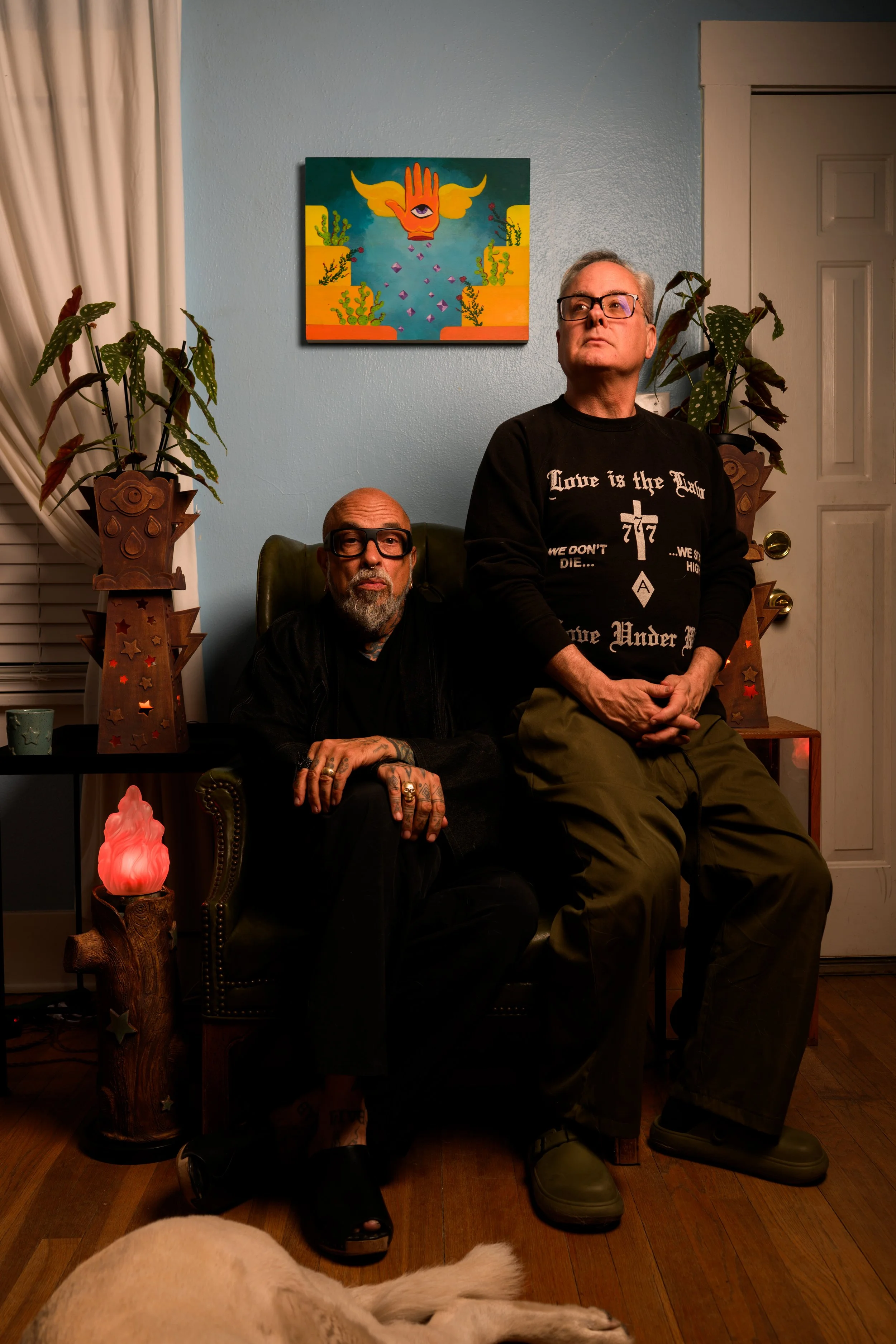
Jess Wamre, who was Mitchell's trusted right hand during the Burial presentation, has come to Tucson to assist. Mitchell had a spare room, and the timing was fortuitous; in August 2023, Wamre was struck three times in a drive-by shooting on Capitol Hill—one bullet grazed his left knee, another his right hip, and the last his jaw. He needed a break from Seattle. They've been at work all morning on sculpted tree trunks that will be part of the large installation in the show's last gallery. Mitchell describes them as "acid-regency" and "Deco-psychedelic." He details his to-do list: four more hanging lamps, two big floor lamps, and a clock to go in the middle of a table in the lower part of the piece, "because the sense of time running out is so extreme right now." In front of the clock, he wants a big oval bowl with roses from his garden floating in it. Flanking the table will be fourteen-inch-long hanging lamps with five-foot tassels falling from them, and a depiction of Mitchell and Reighley in the center of everything.
With the likelihood of Obergefell v. Hodges being overturned by the corrupt and supremely bought Supreme Court, and the concomitant ascendance of Christofascism, queer domesticity is suddenly charged, again, with a sense of being under threat. The aforementioned centerpiece is a ferocious folkloric family portrait of Mitchell and Reighley, wearing $14 French-court wigs with their rescue dog, Ghost, who will wear an Elizabethan ruffle collar. The tableaux will also have, Mitchell says, "a machete we got as a housewarming gift and a big murder knife I found on the street with serrations and cutouts, so when you stab someone you pull out their guts."
Mitchell is making art attuned to the present currents, the moment aligning with yearslong work. Confronting death rituals, white supremacy, and homophobia, Mitchell moves against the dominant narrative with a witchy resistance. The mystical Brazilian author Clarice Lispector calls this "the magic that is the opposite of, 'open, Sesame.'" He plans to include selections from White Work that haven't ever been shown, including meticulously crafted Klan hoods that provocatively risk misreading, much like Philip Guston's antiracist paintings from the late 1960s. In Guston's case, a traveling retrospective scheduled to start in 2020 was postponed by the four sponsoring institutions in a collective flinch; who knows what the response to Mitchell's will be.
A selection from Burial will also be included: a few pairs of shoes, an embroidered scarf dress, and the large, framed ensemble Waxie Moon wore. Then there's a photographic self-portrait made for a show at Lundgren's Museum of Museums in Seattle. In it, Mitchell, covered by a long black veil, wears baby blue goatskin gloves pierced all over with cactus needles, shown in a full-throated scream that took all day to perfect, requiring the artist to run between the camera and the backdrop, screaming over and over again. At Pidgin Palace, the print, which will be shown bracketed by the gloves, punctuates the Seattle period before the display transitions to the ceramic works, then ends with the family portrait and domestic tableaux. The culmination of the survey feels like something of a rebirth, after the decade of relative quiet that followed the success of Burial, when Mitchell felt he was "wandering through the desert struggling. Literally, in our case, wandering. Now I have my power back. I'm 62. I'll be 63 in June, and I feel like I'm just getting started."
I want to ask one of those impossible questions: In our atmosphere of swarming despair, how do you find a way forward? Academics and online activists have yammered about queer utopias for the past half-decade, as a way to uplift but also often as a way to suppress and dismiss negativity, even grief and pain and loss into an archive. They have established a dominant narrative that demands possibility only rooted in positivity and community-building without also admitting that negativity, even grief and pain and rage, can be generative and lead us to discover secret codes to daily liberations.
Mitchell may or may not have one eye on the doomsday clock, but he is clearly, firmly in the present, making art for now and for the future. He emphasizes what we do with our time, making it count, confronting injustice, and as fascism takes firm hold, insisting on rebellion. His art circles acknowledgment and remembrance, or more pointedly in our current hellscape, it refuses to forget. It refuses to be white-straight-Christian-washed. Mitchell encodes survival, and the darkness from the height of the AIDS crisis, into his work. It's a private message, like the ones sewn into Burial's shrouds. The knowledge is there, radiating. Powerful, yet hidden. The message now is queer domesticity, enshrining love at the center of all Mitchell does, and in particular the life he's built with Reighley, a love that continues to be imperiled by the worst the world has to offer. Yet his isn't a siege mentality or a defeated worldview; it's upset, enraged, but always seeking beauty and life.